

Start Here

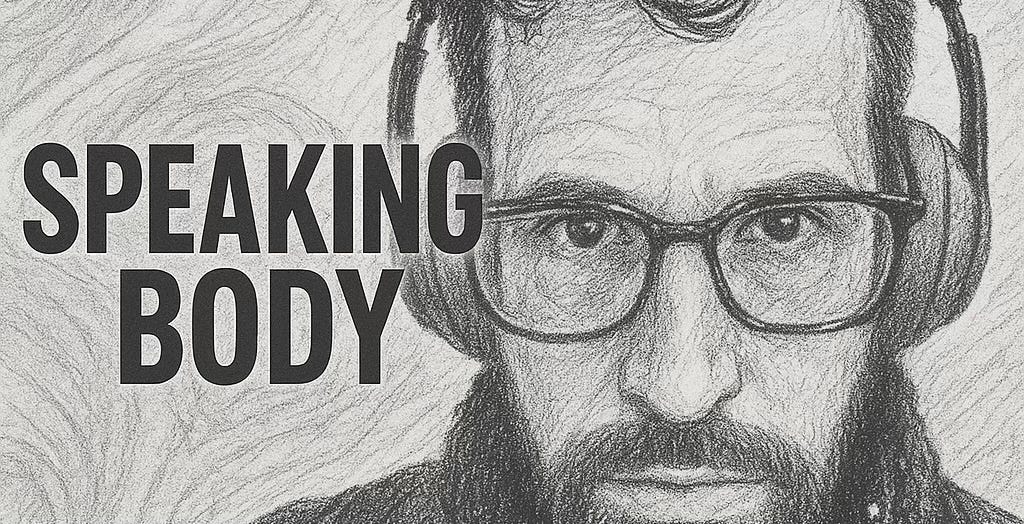
Welcome to Speaking Body
A website, podcast, newsletter, and (occasional) video series where I discuss psychoanalysis through a Lacanian orientation, treating it not as a closed-off, fancy-book-learning kind of theory but as a living set of ideas and practices that affect the body, symptoms, desires, impasses, and modes of jouissance (i.e., the ways people produce enjoyment and suffering).
Sometimes, I’ll examine psychoanalysis primarily as a clinical practice. However, I don’t want to stop at the clinic walls, so there will also be times when I explore how psychoanalytic practices affect subjects as they live their day-to-day lives outside the confines of a psychoanalytic session.
It is also an examination of how psychoanalysis intersects with other areas such as art, politics, technology, fitness, and other sundry aspects of contemporary life. My aim is to examine these intersections with rigor, openness, and curiosity.
Why am I going to the trouble of making Speaking Body:
There is a lot of content that engages with psychoanalytic theory, and much of it is very interesting. However, there is less content that focuses on psychoanalysis as an experience. My hope is to fill that gap with what I express here.
In addition
I find that much of the material that seriously engages with Lacanian theory or practice can be dense and difficult to understand. There are many reasons for this, but the chief among them is that Lacan’s writing and his seminars are full of terms and symbols (e.g., mathemes, graphs, formulas, etc.) that are not part of everyday speech. In addition, Lacan uses everyday words (such as desire, love, and real) in novel ways that differ markedly from how most people use them.
Learning “the Lacanian parlance” requires effort on the part of the person reading Lacan’s words. If someone puts in the work and learns the specialized vocabulary, it becomes possible to speak with others who share that vocabulary in very interesting and productive ways. This is a worthwhile reward for the work you've put in!
Be that as it may, the Lacanian parlance can also be a kind of crutch that Lacanians use to say things in ways that can be understood by non-Lacanians. I’ve personally seen people use the parlance to hide how much they don’t know about psychoanalysis. (When someone says something in a language you don’t know, it is difficult to challenge them or ask them questions.) I’ve also seen people spend a lot of time arguing over what a specific term means, rather than saying what they want to say in a way that does not require the term with a contested meaning.1
Thus, one of the things I want to do by making Speaking Body is speak in two languages.
I don’t want to dumb things down, so there will be times when I use lots of fancy Lacanian terms, symbols, and formulas.
But, when I do this, I’m also going to try to re-describe what I say with Lacanian language in using everyday language, so that people who are not deeply steeped in Lacan might come to understand something about the Lacanian orientation.
If all that sounds interesting to you, great! I hope you’ll keep reading, listening, and watching what I make.
Who am I?
To get this started, I’d like to tell you about me and how I came to be interested in psychoanalysis in general and the Lacanian orientation in particular. I’d also like to share a very small amount about how I’ve experienced psychoanalysis, how that experience has affected me, and how it has shaped the way I live my day-to-day life.
I’m Neil Gorman: I’m a practicing Lacanian psychoanalyst, a member of the Lacanian Compass, the New Lacanian School (NLS), and the World Association of Psychoanalysis (WAP). I’m a Licensed Clinical Social Worker (LCSW) who holds a Master’s in Social Work (MSW) and a Doctorate in Social Work (DSW) from the Aurora University George Williams School of Social Work. I also have a Bachelor’s degree (BA) in history from Northern Illinois University and a public educator’s license (PEL) that authorizes me to teach history and other social studies to students in grades 6-12.
I’ve been working in the mental health field since 2005, when I landed a entery level job at a substance abuse treatment center. Since that time, I’ve worked in treatment centers, schools, a university, and two large group practices.
Today, I own and operate a small clinical practice called Interlude Wellness in Downers Grove, Illinois, where I see patients and analysands in person and via HIPAA-secure telehealth platforms.
My interest in psychoanalysis really took hold when I was in graduate school. I was taking a course called The History of Psychological Theory, and one of the first things we read was Freud’s introductory lectures to psychoanalysis. I had read a little Freud before that, and lots of secondary literature on Freud, but this was the first time I read Freud seriously, and I was completely captivated.
I continued reading about Freud and the psychoanalytic thinkers who came after him, which led me to Winnicott. I was very fascinated by Winnicott’s thought and clinical style, so I did a lot of extra reading about him.2
One day, I found a book titled Between Winnicott and Lacan: A Clinical Engagement. When I found it, I had never heard of Lacan. However, after reading a few chapters, I was convinced that Lacan was probably a very interesting thinker.
Curious, I ordered a copy of Lacan’s Écrits and, when it arrived, tried to read it. I was a fairly successful graduate student and thought I could handle this “difficult” text if I really put my mind to it. However, I discovered that the Écrits resisted all my attempts to understand it! Be that as it may, I was intrigued by what I did not understand. (Perhaps I was intrigued because I did not understand it.)
I reached out to people who had spent a lot of time with Lacan, and almost all responded generously. Many offered me help, and with their help, I came to understand Lacan’s writing a little bit more, and then a little bit more than that. This continued for a long time.
After I defended my dissertation and completed my graduate work, I found a Lacanian analyst and officially entered into my experience of psychoanalysis as an analysand.
Now, many years have passed, and I find that I continue to be fascinated by psychoanalysis, particularly Lacan’s approach.
My aim with writing Speaking Body is to share what I’ve learned with those who are interested.2
I’m immensely grateful to you for taking the time and attention to the things I make and put here. I hope you find them interesting and useful!
-Neil
For me, this is one of the most frustrating things about working within the Lacanian orientation.
This is also my attempt to return the generosity so many people offered me in my own attempts to read and understand Lacan.