

The Intersection of Psychoanalysis & Secular Buddhism
In an ethics that resists the seduccitve feeling of being certain

The Lead
For most of my life, the academic calendar has organized my life. It started in elementary school, continued through middle school and high school, then through community college, a bachelor’s program, and finally graduate school. After earning my undergrad, I became a high school teacher, and after I eventually finished grad school, I became a university professor, which prolonged the prominence and influence of the academic calendar well into my adult life.
As a teacher and a professor, I would spend the academic year giving a set of preoccupations the majority of my available thinking space. These preoccupations were networks of ideas I had been actively refining via researching and teaching. The kinds of things that were on the “front burner” of my mental stove. This work, more often than not, left me feeling like I had learned interesting things. However, I also felt a cognitive version of what I felt like physically after doing a very long run: spent, worn out, in need of some recovery time.
So, when the long summer break arrived, I would work less, indulge in pleasure reading and watching films, read widely, and generally let my mind wander, spending time with ideas (usually new ones) that I did not have the time or energy to explore during the more structured academic year.
Today, I’m not a student or an academic. Be that as it may, summer is still a time when I slow down the pace of my work and go into more of a research and reflection mode, when I try to suss out what direction(s) I’d like to devote my time and attention to next.1
I’ve been in my summer mode for a few weeks now. I’ve been thinking about things and considering ideas at a much slower pace, and I’ve come across some really interesting things that are (mostly) new to me. While this new stuff isn't the psychoanalytic ideas I like to think about, I’ve found that putting it in conversation with familiar psychoanalytic ideas is surprising and fascinating.
The Nut Graft
One of the things I’ve been spending time exploring is the writings of the secular Buddhist Stephen Batchelor, whom I discovered via an episode of the Ezra Klein show (on the NYTimes website and on YouTube).2

As I explored more of Batchelor’s writing, I was very struck by how he consistently described his Buddhist practices as an ethics of uncertainty that is grounded in engaging with and then making use of not knowing things about ourselves, our minds, our desires, our day-to-day subjective experiences, and so on. The more I read Batchelor, the more I realized that he was describing how not knowing about ourselves and others makes us more curious.
After hearing this interview, I read the book After Buddhism (Amazon, Bookshop), where Batchelor formulates a secular form of Buddhism stripped of metaphysics and ontology.
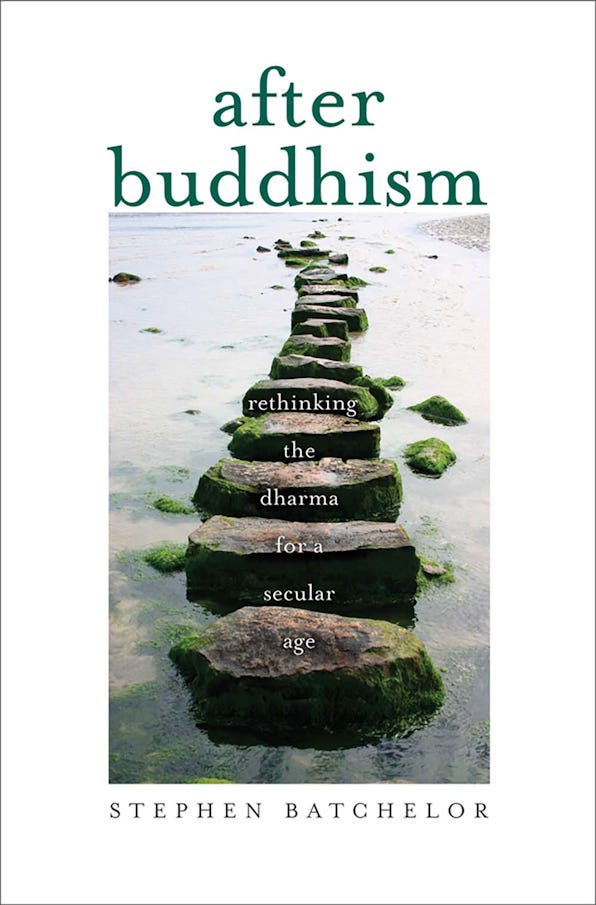
After listening to the Ezra Klein interview, reading this book, and watching more of Batchelor talking in YouTube videos, I noticed how he points out that when we feel certain, we are more likely to act in ways that tyrannically impose what we believe to be right on our own behavior and on the behavior of others. Batchelor also puts forward a compelling argument that a far more ethical way of acting in the world becomes available when a subject develops a capacity to resist the seductive affective feelings that accompany certainty. The ethics of Batchelor’s secular Buddhism are an ethics of not knowing and knowing that we don’t know. It is an ethic that takes what we assume to be true and questions it. It is a sustained gentle curiosity (as opposed to a rigid certainty) directed towards our subjective experience, others, and the world we share with others.
The more curious we are, the more we slow down and become interested in what is happening within and around us.
The more unsure we are about our preferences, the more interested we become in why we developed them, and the less likely we are to impose them on others.
The less certain we are about what we know, the less we try to assert or prove it, and the more open we are to learning.
The Kicker
When I read Batchelor describing these practices, I found myself thinking that it sounded very similar to the practices I’ve tried to cultivate in my formation as a Lacanian psychoanalyst and the ideas that I’ve been trying to transmit to you via the Speaking Body podcasts and videos I’ve made.
I’m also in the very early stages of forming a new cartel to explore the intersection of Lacanian praxis and theology. My plan is to see what happens when I put this secular dharma alongside and in conversation with Lacanian praxis.
To do this, I’ll continue reading Batchelor and other Buddhist thinkers through my Lacanian lens, and I’ll share what I discover here by sending out a written account of what I’m learning every two weeks or so.3
Sundry Stuff
I suspect that the dispatches I send out about this will be:
Short (although damn near every time I say I’m going to make things short, I end up not doing that and writing long stuff… So… Who knows).
More like rough drafts than finished products.
Organized like this dispatch has been organized, with a lead, nut graft, kicker, and sundry stuff sections.4 There will be a few footnotes too.5
If you happen to be interested in reading or listening to more stuff about my subjective experience of time, you can find a lot more stuff at From78.
All of these links point to the same interview, but the NYTimes link is behind a paywall.
My first impulse was to share what I learn as a podcast, and I might still do that eventually. But given that this is the summer—slow-down-and-think time—using the written word is a better place to start.
A common journalistic story structure in which the lead captures the reader’s attention, the nut graf explains the central point and why the story matters, and the kicker provides a memorable closing image, insight, or reflection that leaves the reader with the story’s lasting significance.
Obviously.